BLINC: A Fault-Tolerant Neural Codec for Wireless Real-time Video Streaming
Wireless video streaming is central to applications such as video conferencing, cloud gaming, drones, and AR/VR, but low-latency wireless links are fundamentally different from buffered streaming services. In interactive settings, retransmitted packets may arrive too late to be useful, while traditional codecs often discard corrupted packets entirely after checksum failure, causing undecodable frames, stalls, and error propagation across subsequent frames.
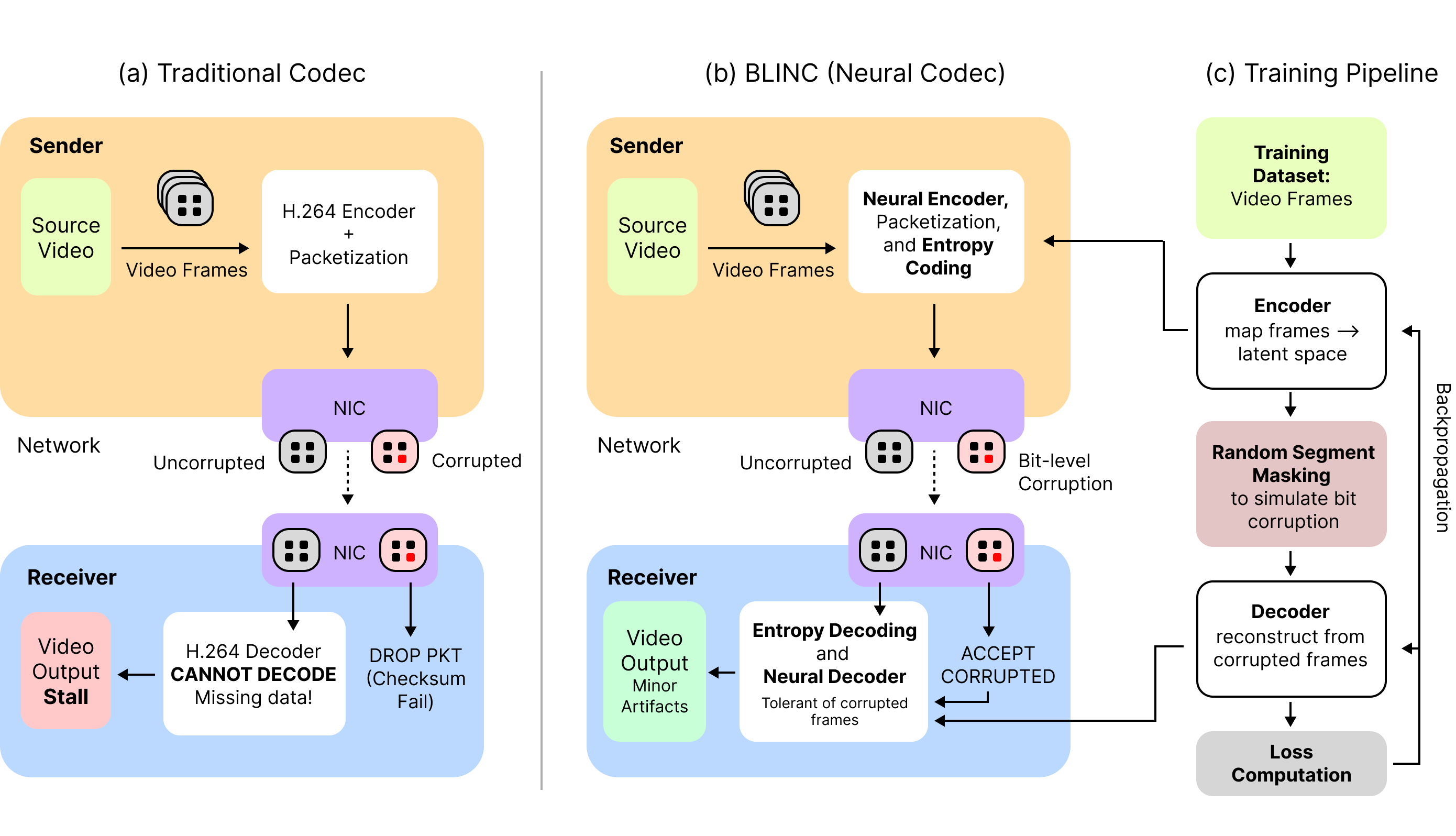
This work presents BLINC (Bit-Loss Insensitive Neural Codec), a fault-tolerant neural video codec designed for real-time streaming over noisy wireless links. BLINC builds on packet-loss-resilient neural codecs by targeting bit-level corruption, which is common in wireless channels but usually hidden by link-layer CRC checks and retransmissions. Instead of treating a corrupted packet as unusable, BLINC divides entropy-coded representations into small independently decodable segments, fine-tunes the neural codec with random segment masking to simulate corruption, and integrates with the Wi-Fi layer so receivers can accept partially corrupted packets and avoid unnecessary retransmissions.
We evaluate BLINC with a Python/PyTorch codec implementation and an ns-3 Wi-Fi simulation using an 802.11ac two-node setup with varying client distance and target bit error rates. Across target BER settings, BLINC achieves higher PSNR and SSIM than GRACE, a prior packet-loss-resilient neural codec, and maintains high visual quality up to a target BER of 1e-3. These results suggest that neural codecs designed for bit-level corruption can shift wireless real-time video away from brittle all-or-nothing packet recovery and toward graceful quality degradation, lower latency, and more efficient use of wireless airtime.