Three pressures
Horse-drawn transportation fell out of favor due to
- biological limits
- ecological burdens
- economic inefficiencies
These collided with the electric and motorized alternatives.
21A.500 · Technology and Culture
Horse-drawn vehicles were an essential form of transportation for thousands of years, from early Mesopotamian, Egyptian, and Greco-Roman chariots and carts to the carriages prevalent throughout the 17th–19th centuries in Europe and North America. Horse-powered transport also shaped urban infrastructure, from Roman roads with wheel ruts that guided carts to nineteenth-century cities built around carriage traffic and stables. This exhibit analyzes the decline of horse-drawn transportation in the early twentieth century with the rise of mechanized vehicles, examining what factors kept horse-powered systems relevant for so long and what tradeoffs ultimately enabled mechanized transportation to replace them.

Historical image
New York City: hansom driver with horse and cab (street types series, Library of Congress)—public domain, Wikimedia Commons.
Hover or tap a region on the image.
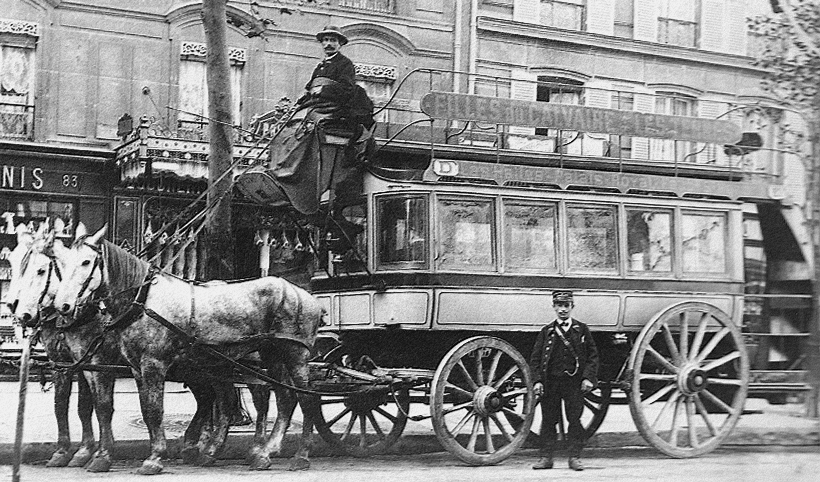
Horse-drawn transportation was a critical tool for mobility, especially prevalent throughout the seventeenth to nineteenth centuries in Europe and North America. It enabled the large-scale movement of people, goods, and services, addressing the “last mile problem.” Its most widespread form (e.g., wagons, carts, carriages, omnibuses, and horsecars) became essential to daily urban life. These vehicles were used to transport people for everyday travel, deliver commercial goods, carry industrial materials, and support essential city services such as firefighting, mail, and street maintenance. In rapidly growing cities, horse-drawn systems connected rail depots, markets, and residential areas, making them key to rapid urban industrialization. Nineteenth-century cities with populations over 100,000 averaged a horse-to-human ratio of one to fifteen.[1]
At its core is the harnessing of the biological power of horses to the mechanical energy needed to carry and pull heavy loads across large distances of roads. In the nineteenth century, horses were widely seen as machines rather than as mammals.[1]
However, horse-based transportation is more than just a form of vehicle, but a broader and more complex technological system ingrained into the urban infrastructure itself. It required the upkeep of an ecosystem comprising roads, stables, feed supply systems, and human labor. It required a constant supply of grain, hay, water, and workers. In addition, manure became a significant byproduct, closely tying the transportation infrastructure to waste management and urban sanitation.[1][7]
Where and why does it originate? What need or desire does this technology fulfill? Is this a novel technology? Is it the popularizing of much older traditions?
Animal-drawn transport can be traced back to ancient civilizations. It appears as early as 3,000 BCE in Mesopotamia. As an agricultural society, the Mesopotamians used ox carts for the transportation of agricultural goods and equipment. The transition to a horse-drawn carriage emerged after the domestication of horses around 2000 BCE.[8]
Horse-drawn transportation, specifically horse-drawn carriages, is not a novel technology. In fact, there is a very similar predecessor, the chariot. Chariots were originally invented in Mesopotamia and Egypt for warfare, cultural ceremonies, and even sport. As time went on, these chariots became normalized. No longer were horse-drawn carriages reserved for these special circumstances. More and more people began using horses for transportation on a regular basis. As the technology began to spread around the world, the chariots’ technology began to evolve.[8][12]
Horse-drawn chariots became important due to their utility on the battlefield in ancient Mesopotamia. Evidence from the Sumerian Standard of Ur (2500 BCE) depicts battlewagons being pulled by wild asses called onagers. These wagons had solid wheels and were heavy. As the wheel itself evolved to become spoked and horses were domesticated, in 2000 BCE, the horse-drawn carriage emerged. These lighter-weight chariots played an important role in the military. The concept of the chariot (a horse-drawn carriage) spread across many ancient civilizations.[8][9]
Without the need for maneuverability, the two-wheeled chariot could be replaced with a four-wheeled cart. This allowed for a much more comfortable ride, while placing much less strain on the horses. With this new improvement, the ability to travel long distances became much more common. As travelling a long distance became a normality, people needed protection from the environment, such as from rain and storms. They also needed protection from thieves. The solution was to add a roof to create a carriage. This way, any riders would be shielded from the cold and weather. Additionally, riders had privacy against any thieves scheming to steal.
With these additions and new innovations, the older reasons and traditions behind chariots died out. No longer were they used in races or in ceremonies. Empires collapsed and cultural significance died out. Horse-drawn carriages began to represent something new. Utilizing horse-drawn carriages instead represented wealth and class in the European cities.[10]

Horse-drawn carriages exploded in popularity during the rapid urbanization of Europe. As European cities expanded, travelling between them became more and more prevalent. The number of roads multiplied, and the quality improved. As a result, a new, improved mode of transportation was needed. Horse-drawn carriages filled this gap. Up until this point, there was no reason for horse-drawn carriages to emerge. Once the roads increased in quantity and quality, the next step was to increase horse domestication on a large scale. With the increase in the population of horses to pull the carriages, there were no other roadblocks.[5]
Like many innovations in the world, another driving force was war and defense. As troops needed more large-scale supplies, and since roads had improved, wagons and other horse-drawn carriages were able to fill this gap. However, these horse-drawn carriages were not successfully widespread among common people until the suspension systems improved. Once Obadiah Elliott invented the modern metal leaf spring, travelling became much more convenient and enjoyable. This is one more factor for horse-drawn carriages to have the societal explosion that they had.[13]
Lastly, horse-drawn carriages took off with colonialism. Since the United States was so large and people travelled so much, there was a strong need for it to allow for easy transportation. The rapid spread of horse-drawn carriages demonstrates how social, economic, and cultural factors need to align for innovations to have a worldwide impact.
The cities we live in today were built around the horse. Street widths, road grades, materials, and neighborhood layouts all bear the imprint of an era where the fastest thing on the road went at a gallop.
“The history of urban horses matters a great deal and holds valuable information for planners and engineers in the present. Understanding a community’s horse-powered past can reveal a footprint designed for the very low-speed, complete street environment we work so hard to create today.”
Before the horse omnibus, urban travel was either private or on foot. The horse-drawn omnibus, which first appeared in New York City around 1830, changed this entirely by introducing fixed routes and predetermined schedules. By 1853, omnibuses averaged 13,420 trips per day in New York, collecting 120,000 passenger fares, with 683 licensed across the city. [1]
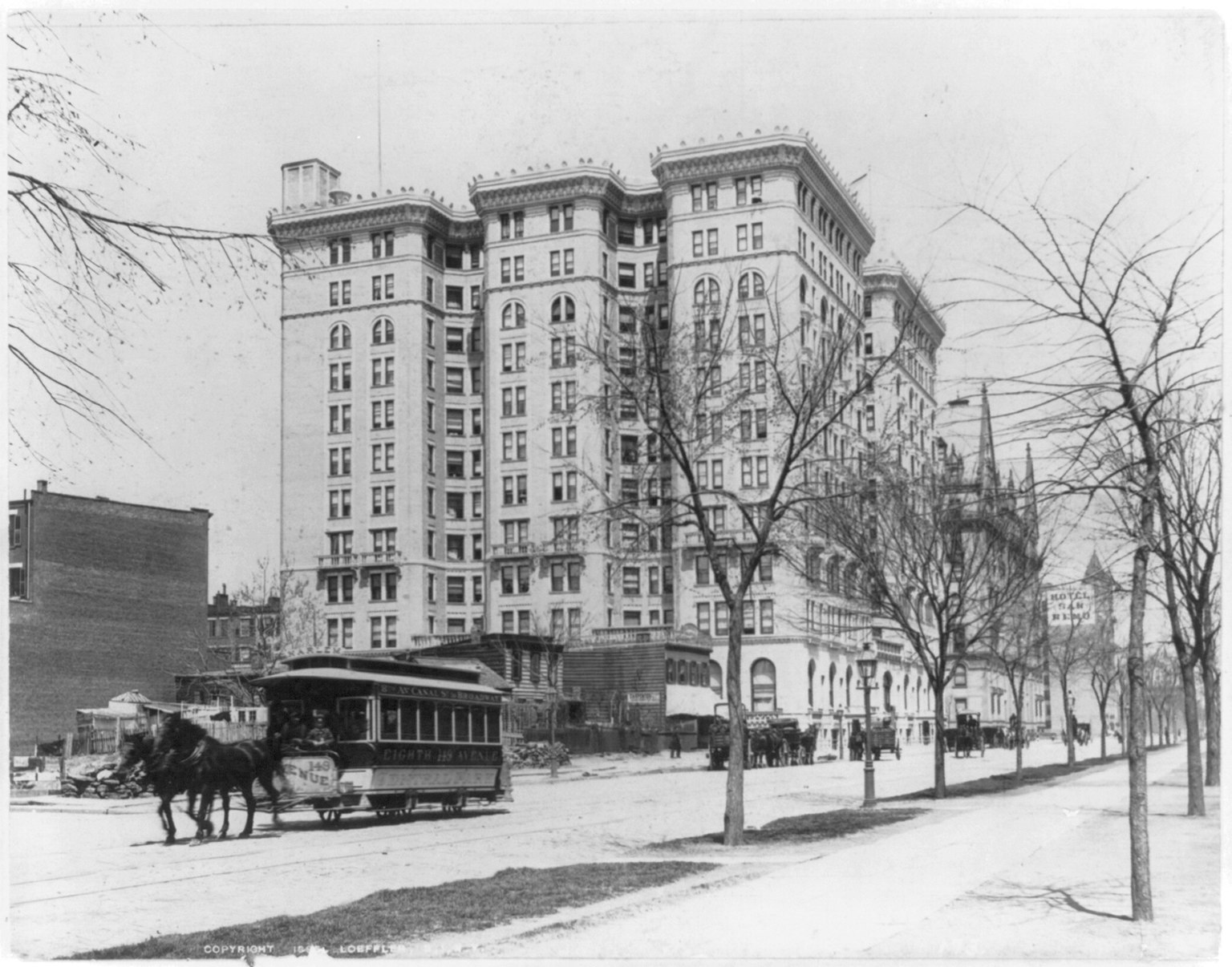
The horse-drawn streetcar refined this further. Running on iron rails, a horse could pull a vehicle at 30% higher speed and carry twice as many passengers as an omnibus. Horsecars became America's first true urban mass transit system. By 1880, horsecar ridership per capita in New York was 127 trips per year; by 1890, it reached 297—a 134% increase in a single decade. [11]
This framework of public transit was invented for the horse, then inherited by every other transit that followed.

Horse-drawn transportation fell out of favor due to
These collided with the electric and motorized alternatives.
Horses require constant
and have short working lives.
By the 1880s, cities like New York had at least 150,000 horses
Cities were overwhelmed by
This created severe sanitation hazards and contributed to disease outbreaks.
Horses also need around three tons of oats and hay per year which would require millions of acres of rural land to sufficiently produce their food supply.[3]
The cost of maintaining horse populations became costly compared to electric streetcars and motor vehicles which could operate longer and carry heavy loads without fatigue.[2][6]
The first horse-drawn streetcar was introduced in 1832 which allowed fewer horses to carry heavier loads and passengers a smoother ride.
Electric transit systems in the 1880s provided higher speeds, greater capacity, and lower operating costs than horsecar lines.[6]
Electric vehicles paved the way for rapid mass transit.[4]
Against resurgence
Resurgence of horse-drawn vehicles is unlikely due to ecological limits: manure, disease vectors, and carcass disposal which would lead to sanitation problems.
Horses would also be unable to commute large distances that we have grown accustomed to on a modern urban scale.
Ethics & law
Although the usage of horses as tools of labor was a standard in the nineteenth-century, using horses as a main source of labor would now raise ethical and legal opposition depending on animal treatment.
Performance
Modern transit continues to vastly outperform horses in speed, capacity, energy, and cost efficiency.
Limited niches
Some cases where horse drawn vehicles may reappear are for tourism purposes which appeal to historic events as a cultural experience rather than for strictly transportation purposes.
Rural use
Could also be used for small-scale farming in specific rural settings.
3000–500 BCE
Light, often two-wheeled vehicles, were built for speed and used in war, sport, and ceremonies. [8]
500 BCE–c. 1600 CE
As use widened, designs transitioned from two-wheelers to heavier four-wheeled forms that traded maneuverability for load capacity, comfort, and protection from weather. [8]
17th–19th c
Cities came to run on large horse populations, connecting markets, depots, and homes. Horse-drawn modes became a defining part of everyday transport. [1][2]
1830s-
Omnibuses and horsecar lines (e.g. New York horsecar) implemented routes, fares, and schedules, enabling mass public transportation through rapidly industrializing city centers. Peak horse to human ratioes followed in the largest cities. [1][2][4]
1880s-
Street railways and, later, motorized vehicles offered alternatives to efficient transportation. Biological limits and urban sanitation pressure helped tip the balance in favor of these newer technologies. [2][3][6]
1900–1930 CE
In many places, mixed use of horse and motor transport gave way to changing infrastructure designed for motor vehicles and fixed-route electric transit, though full replacement took time and we still see the remnants of the impact of horse-based transportation to this day. [1][2][6]